The Best Sage Green Paint Colors for a Bedroom (Seen in Real Light)
Nine real sage greens from Sherwin-Williams, Benjamin Moore and Farrow & Ball, sorted by light reflectance value, with trim whites, a sampling routine and the right sheen for bedroom walls.

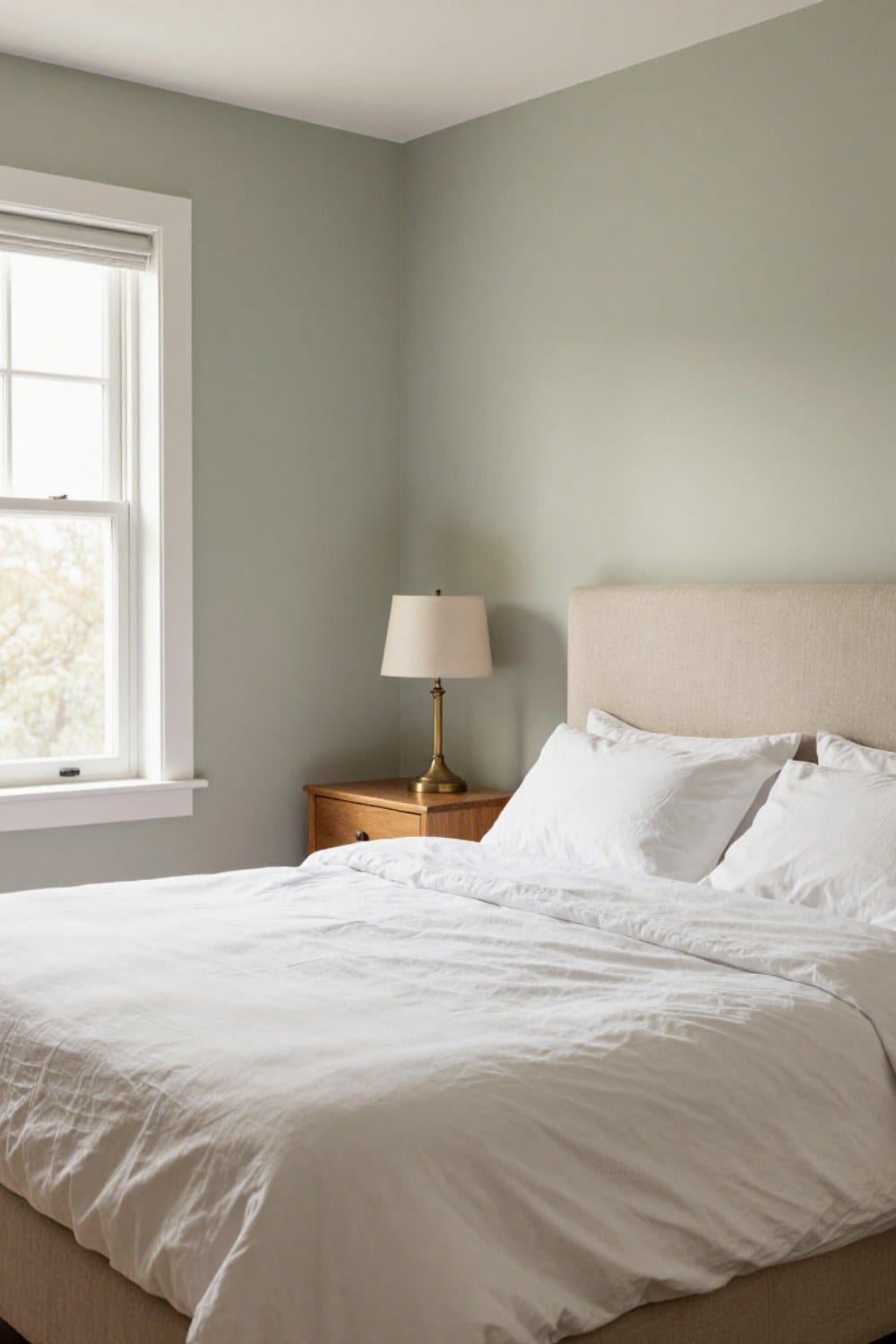
Every sage looks right on the chip. Then it goes on the wall and one turns gray, another goes minty, and the one you loved at the store looks like a hospital hallway by four in the afternoon. I have repainted a bedroom over a sage that did exactly that, so this is the list I wish I'd had: the best sage green paint colors for a bedroom, with the number that actually predicts how each one behaves.
Everything named below was checked against the maker's own page in October 2026. Where a maker describes a color, I quote them. Where they don't, I stay with the numbers and with what testing will tell you. If you're still deciding on the whole room, start with the sage green bedroom ideas and come back here when it's time to buy a sample pot.
Nine sages. Four deeper greens for later. Two trim whites. No color here is a promise, because your light gets the final vote.
The number on the chip that matters most
LRV stands for light reflectance value. It runs from 0, which is black, to 100, which is white, and it tells you how much light a painted wall bounces back into the room.
Think of it as a dimmer switch built into the paint. Two sages with the same leafy look but LRVs of 30 and 57 are two different bedrooms.
My first sage bedroom was a deep one with an LRV in the low 30s, on the north wall of our guest room. In July it looked like moss. In January it looked like a wet slate roof. I loved the color and hated the room.
So read the number first and the name second. And remember it's a figure from a spec sheet. Your windows, your bulbs and your floor all push what you see up or down from there.
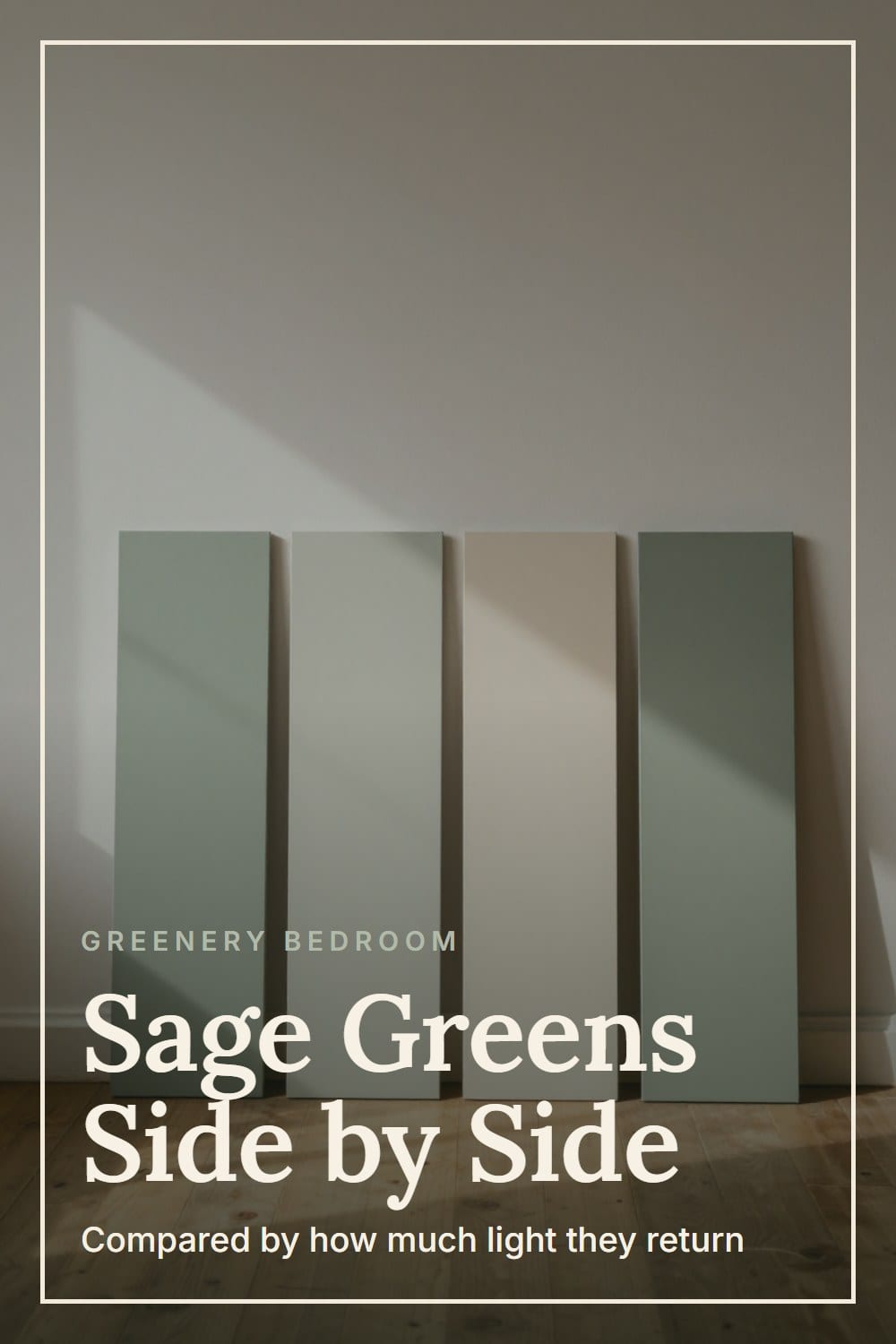
The best sage green paint colors for a bedroom, lightest to darkest
Here are the nine, in order from the most light bounced back to the least. Ties are marked. LRVs are rounded to a whole number.
Benjamin Moore Soft Fern 2144-40, LRV 57
The lightest sage on the list, and the first one I'd sample for a bedroom with weak daylight. Benjamin Moore calls it “a pale green misted with gray tones.” At 57 it returns more light than anything else here, which also means that in a bright south-facing room it can read pale by noon. Check it then.
Sherwin-Williams Softened Green SW 6177, LRV 49
The lightest of the Sherwin-Williams sages here. I'm sticking to the number, since I have no maker description to quote: at 49 it is the second-lightest sage on this list, so it should read as a clear, light wall rather than a deep one. A sensible first sample for a north-facing room.
Benjamin Moore October Mist 1495, LRV 47
Benjamin Moore says “this gently shaded sage anchors and uplifts.” It's two points under Softened Green, close enough that you'll want both boards on the wall before you choose. I like it for a room where sage is the whole story, bed wall to window wall.
Benjamin Moore Salisbury Green HC-139, LRV 46
Described as “a mid-toned green with prominent gray tones.” Take that as a fair warning. Gray tones are what make a sage feel calm, and also what can make it go flat in a dim room. Test this one at the darkest hour you'd actually sit in the bedroom.
Benjamin Moore Saybrook Sage HC-114, LRV 45
“A soothing aloe hue cooled with a splash of gray,” in Benjamin Moore's words. It lands one point under Salisbury Green, so the chart can't separate them. Put the two boards side by side and let your own eyes decide which one feels like your room.
Sherwin-Williams Clary Sage SW 6178, LRV 41
At 41 a sage starts to feel enveloping instead of airy. It's a good candidate for an east or south room that has light to spare, where a mid-depth wall will look rich in the morning and settle down by evening.
Sherwin-Williams Svelte Sage SW 6164, LRV 41
It ties Clary Sage at 41. Same brightness, so whatever difference you see between them is hue, and a number can't show you hue. Hold both chips up together, then both boards. I changed my mind twice between two sages this close.
Sherwin-Williams Evergreen Fog SW 9130, LRV 30
The deepest sage on the list. At 30 it takes in far more light than the 57 at the other end, so in a north room it will go dim quickly. In a sunny bedroom it's the one to pick if you want the walls to wrap around the bed, and 2700K lamplight is kind to it.
Farrow & Ball Lichen No. 19
Farrow & Ball call it “a mid aged green” with an underlying blue tone. I couldn't confirm an LRV for it, so I won't give you one. That makes sampling non-negotiable here. Put it beside your floor and your bedding before you decide, because an underlying blue tone will read very differently against warm oak than against cool gray.
How sage changes from a north window to a south one
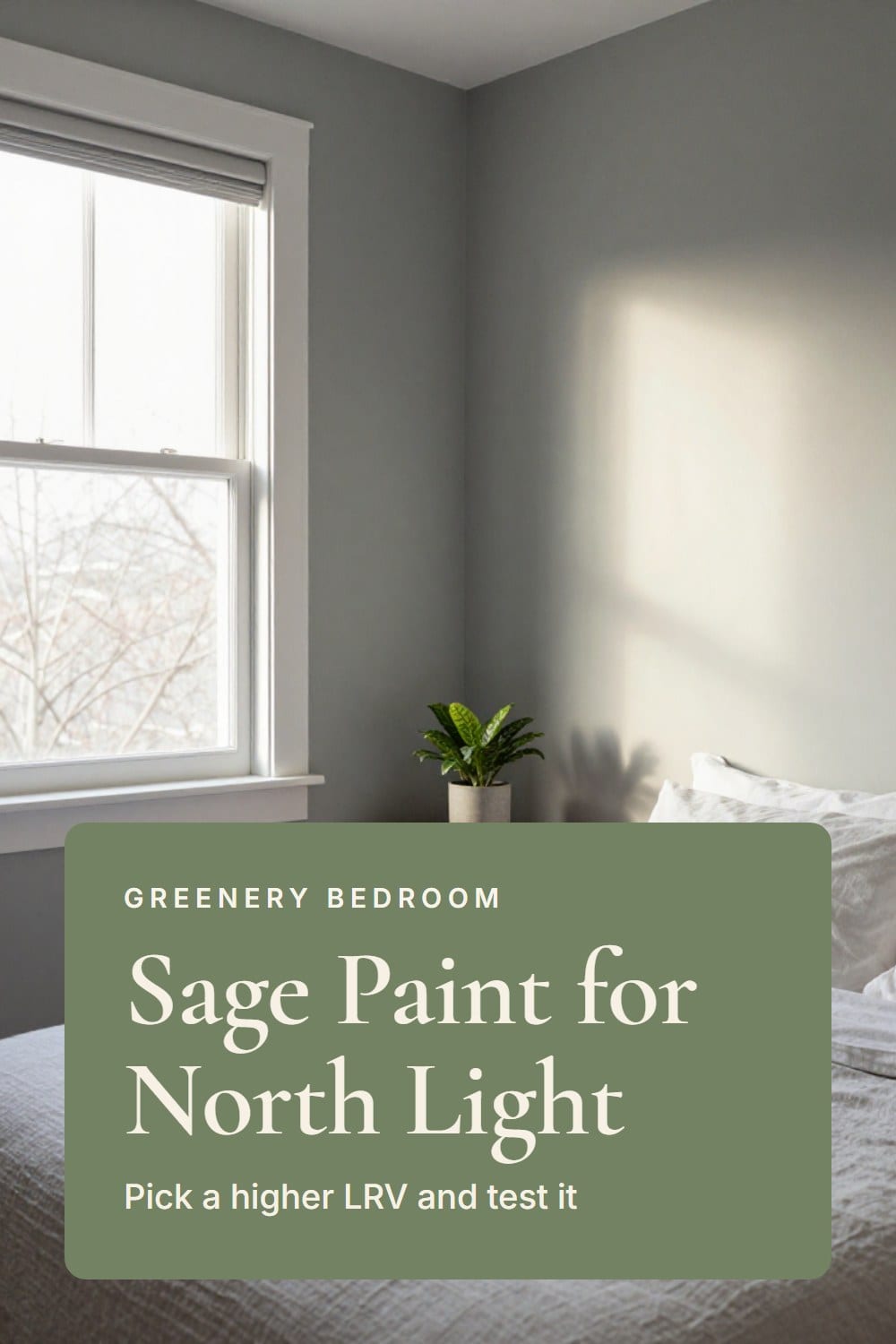
North light is cooler and flatter, and it tends to make every color on the wall look a little grayer and a little darker. South light is warm and bright, and it can make a pale sage look washed out at midday and a deeper one look richer.
That's why the LRV matters so much. In a north-facing bedroom I'd start with the higher half of this list: Soft Fern, Softened Green, October Mist. They have light to give back, and your room has little to spare.
In a south room you have more freedom. Clary Sage, Svelte Sage and even Evergreen Fog can hold their depth, and the brightest light is the thing most likely to wash out a pale one. East rooms are bright early and softer later. West rooms flip it.
A bedroom is used differently from a kitchen, though. You see it in the morning and again at night, mostly under lamps. So the test that counts most is the 2700K bulb test, and I'll get to it in the sampling steps below. The wall that looks lovely at noon is not the one you live with.
Which white goes on the trim
Two whites come up again and again, and both are on the maker pages: Benjamin Moore White Dove OC-17 at LRV 83, and Sherwin-Williams Alabaster SW 7008 at LRV 82.
The useful thing is the gap. Every sage here sits between 30 and 57, and both whites sit at 82 or 83. That spread of 25 to 50 points is what keeps trim looking crisp against the wall instead of muddy.
I won't tell you one is better, because I can't verify that from a chip. Paint a strip of each along the edge of your sample board and see which one sits better against your sage and your window light. If you're leaning toward white walls with a green accent instead, the green and white bedroom post goes deeper on that balance.
How to sample sage green paint properly
A chip the size of a playing card tells you almost nothing. I know, because I have bought a gallon off one. Here is the routine I use now.
- Paint sample boards about 12 x 12 inches or bigger, so you can carry them around the room.
- Give each board two coats, letting the first dry fully.
- Lean the boards on two different walls: one beside the window, one on the far side of the room.
- Look at them in the morning, in the afternoon and at night under your own 2700K bulbs.
- Leave them up for a few days so you see them on a bright day and a gray one.
- Hold a trim white chip against the edge of each board before you decide.
Do this for three colors at most. More than that and they all start to look the same, and you'll end up choosing because you're tired. If you want a printable version, the planner below puts it on one page.
The Green Bedroom Color Planner
The printable is being finished. It will live here, free, with no sign-up wall.
Matte or eggshell for bedroom walls
Matte gives you the softest look. Light falls into it instead of bouncing off, which hides small roller marks and wall flaws and makes a sage look like a quiet, even color.
Eggshell has a faint sheen, and it wipes clean better. I use it on the wall right behind the headboard, where heads and hands and pillows end up. On trim I go a step glossier than the wall, which is also what keeps that white crisp.
If you want it darker
Sometimes the sample board tells you the truth: you wanted more depth. These four are the next step down, and all are on the maker pages.
- Sherwin-Williams Artichoke SW 6179, LRV 21
- Sherwin-Williams Dried Thyme SW 6186, LRV 21
- Sherwin-Williams Pewter Green SW 6208, LRV 12
- Benjamin Moore Essex Green HC-188, LRV 6, which Benjamin Moore calls “a nearly black shade of green”
Notice how steeply the numbers fall. Going from 30 to 21 is a big change, and 12 or 6 is a different kind of room. For how to wear that depth well, read dark green bedroom ideas, or olive green bedroom ideas if the deeper, warmer direction appeals.
A word on jade and the 2026 greens
Pinterest's 2026 palette names jade, which sits softer than emerald and richer than sage, and describes a move away from muted minimalism toward nature greens. Behr's 2026 Color of the Year, Hidden Gem N430-6A, is a smoky jade. If sage feels too quiet for you, jade green bedroom ideas shows how to use it without losing the calm.
Sage paint mistakes I've made
- Choosing from a tiny chip instead of a big painted board
- Judging the color only at noon, when the bedroom is used at night
- Reading the name and the pretty photo instead of the LRV
- Putting a deep sage in a north room and expecting it to read light
- Picking the trim white last, after the walls are already done
Spring is a good time to repaint because open windows help paint dry and the longer days let you sample in more light, but I'd say do it whenever you can. The bedroom refresh wave in January is real, and sage works any month. If you're thinking of one wall only, the green accent wall behind the bed post covers paint, limewash and paneling.
If you're pairing the green with terracotta and warm wood, sage green and terracotta has the palette worked out.
Frequently asked
What is the lightest sage on this list?
Which sage should I try in a north-facing bedroom?
Do I really need two coats on a sample board?
Is matte or eggshell better for a bedroom?
Sarah Whitmore
she keeps the teak, she oils it in spring
Sarah has furnished the same porch three times and finally stopped. She writes about what actually survives a decade outdoors — which wood silvers, which fabric fades, and which inexpensive piece quietly reads the same as the expensive one.
SarahMore from this corner
 Bedroom Sanctuary
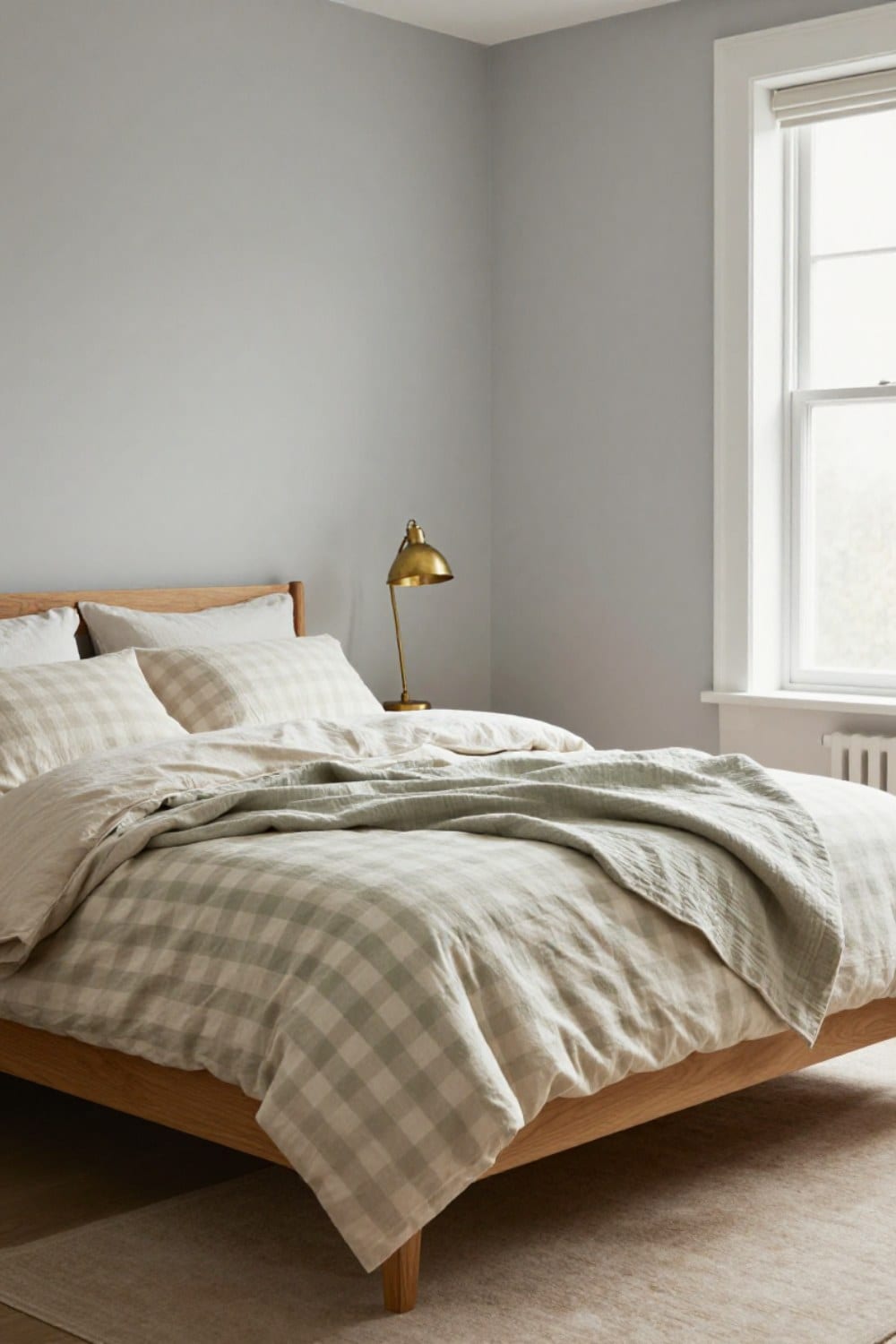
Green Gingham Bedding: How to Style It So It Looks Grown-Up
Green gingham bedding can look calm and collected instead of nursery. Here is how to choose the check size, keep it to one layer, mix it with other patterns and pair it with wood so the bed looks grown-up.
Oct 25, 2026 · 10 min read
 Bedroom Sanctuary
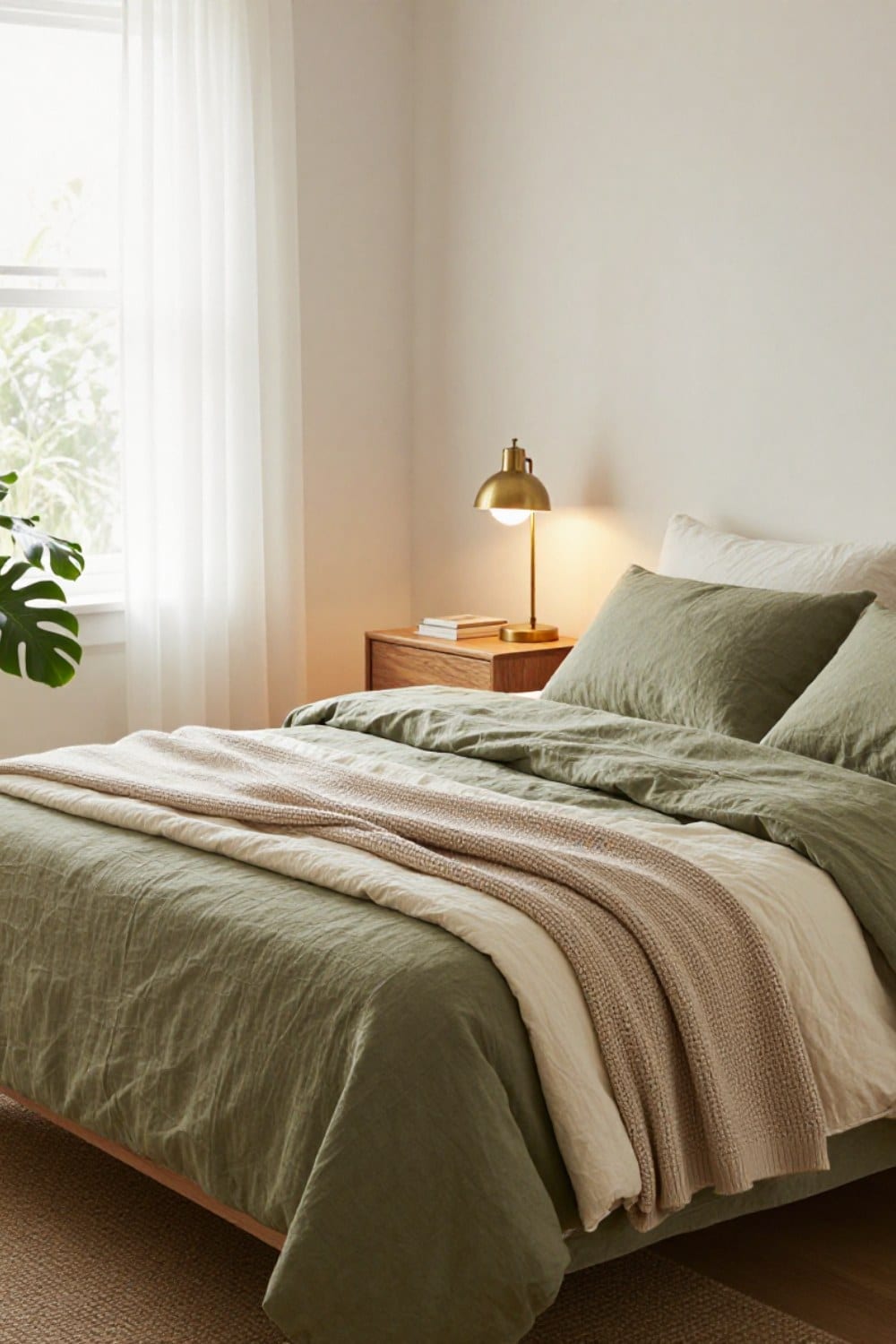
Olive Green Bedding Ideas: How to Make a Green Bed Look Collected
Olive green bedding ideas that make a bed look collected instead of matched: the three-tone rule, the fabrics that read expensive in green, what goes on top, and what belongs on the walls behind it.
Oct 22, 2026 · 11 min read
 Bedroom Sanctuary
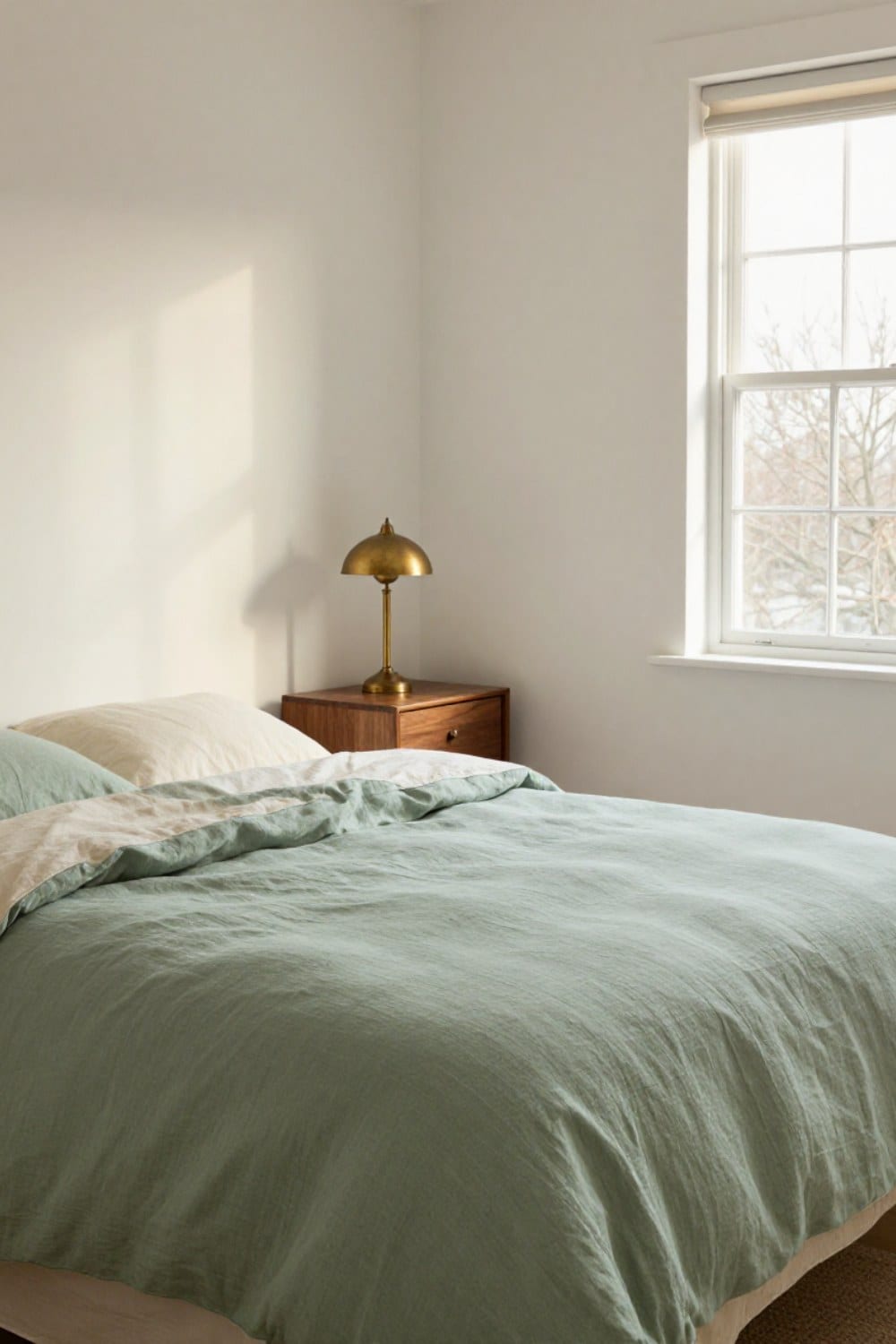
What Color Walls Go With Green Bedding? Six Pairings That Work
Six wall colors that make green bedding look chosen on purpose: warm white, greige, soft plaster pink, taupe, pale sage and deep chocolate or charcoal. Each one comes with the green it suits, how your light changes it, and the wood that ties it together.
Oct 20, 2026 · 11 min read