A Small Christmas Tree for the Bedroom: Tabletop, Slim and Living Trees
A bedroom tree should be seen from the pillow and never tripped over. Here is how to scale, place and light a tabletop, slim or living tree, and when to put it up and take it down.

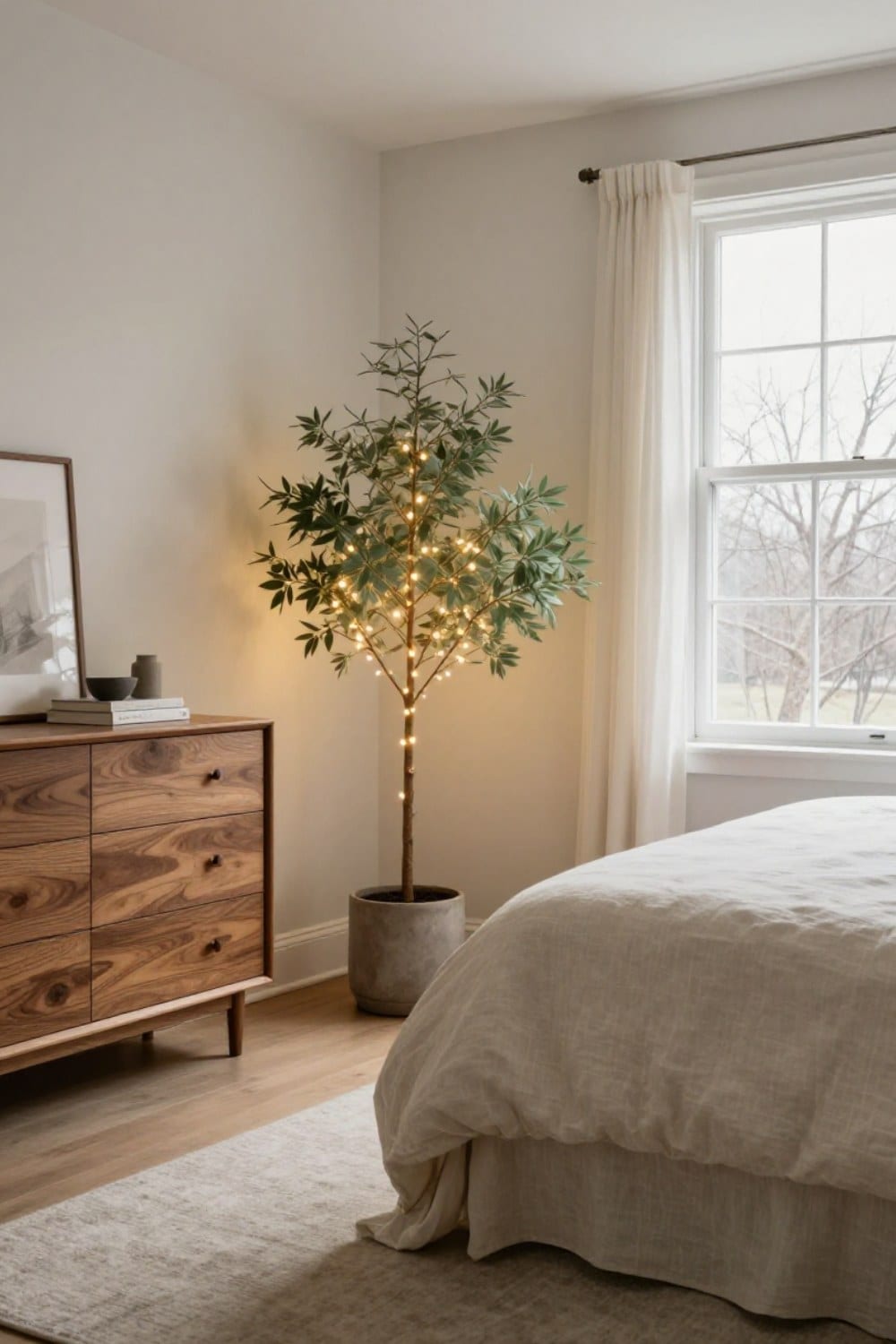
The best small Christmas tree for bedroom use is the one you can see from the pillow and never trip over on the way to the bathroom at 2 a.m. That sounds obvious until you are standing in a store holding a four-footer and realize your room has exactly one free corner, and it is also where the laundry basket lives.
I put a tree in our guest room three Decembers running. The first one was too big. The second one was the right size and the wrong color. The third one is the one I would show you, a modest tree with warm lights, a handful of ornaments, and a basket underneath that hides everything ugly about the stand.
This guide covers the three kinds of small tree that actually suit a bedroom (tabletop, slim and living), how to scale each one to the room, how to light and trim it so it feels calm, and when to put it up and take it down. If you are building the whole room, the green Christmas bedroom decor ideas are the bigger picture. This is the tree chapter.
How to pick a small Christmas tree for bedroom corners and dressers
Start with where it will live, not with the tree. Stand in the doorway and find the spot you see first from the door and last from the bed. That is the tree spot. Measure the height to the ceiling (or to the bottom of the mirror if it hangs above a dresser), the width of the floor or dresser top, and the distance to the nearest outlet. Put the numbers in your phone.
Then choose from three kinds, in order of how much fuss they are.
- Tabletop tree, 2 to 4 ft. Sits on a dresser, console or deep windowsill. The easiest to store, the easiest to light, and the only one that takes no floor at all.
- Slim pencil tree, 5 to 6.5 ft. About 16 to 22 inches wide at the base. Stands in a corner and gives the room a vertical line without eating the walkway.
- Living tree in a pot. A Norfolk Island pine or a dwarf Alberta spruce. Lovely, a little needy, and honest about its limits (more on that below).
Tabletop trees on a dresser
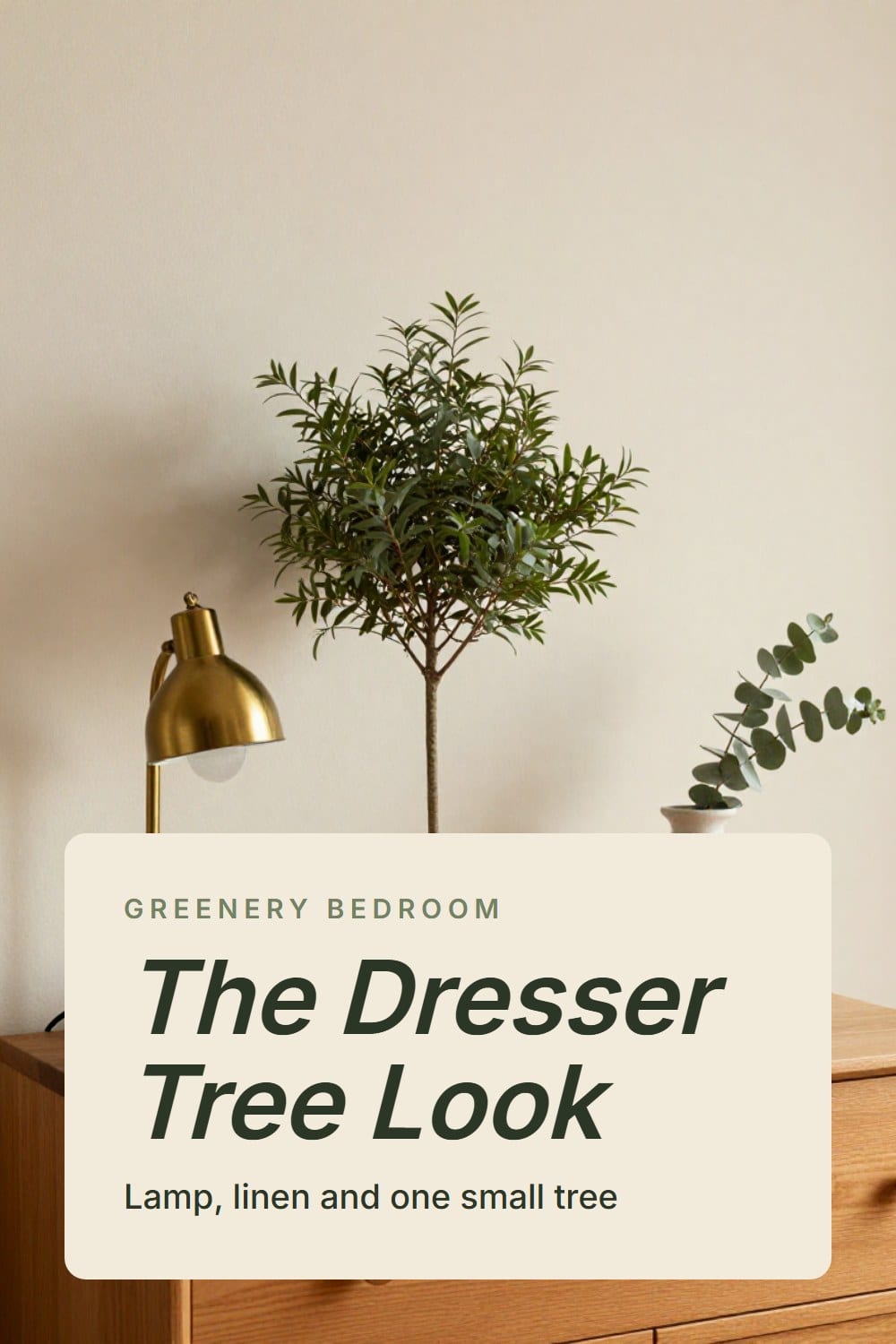
A dresser is the natural stage because it is already at eye level when you sit up in bed. A standard bedroom dresser is 30 to 36 inches tall and 18 to 20 inches deep. Put a 24 to 30 inch tree on it and the tip lands around 5 feet from the floor, right where the lamplight reaches.
The scale rule I use is simple. The tree should be no wider than about a third of the dresser top, and if there is a mirror above, the tip stops at least 6 inches below the frame. Anything taller starts to crowd the mirror and the reflection doubles the clutter. Push the tree to one side, set a lamp on the other, and leave a stretch of bare wood in the middle so the surface still feels like a dresser.
Mine is 28 inches on a walnut dresser 20 inches deep, set about 4 inches in from the edge so a stray elbow does not tip it. The walnut makes the green look deeper.
A slim pencil tree for the corner
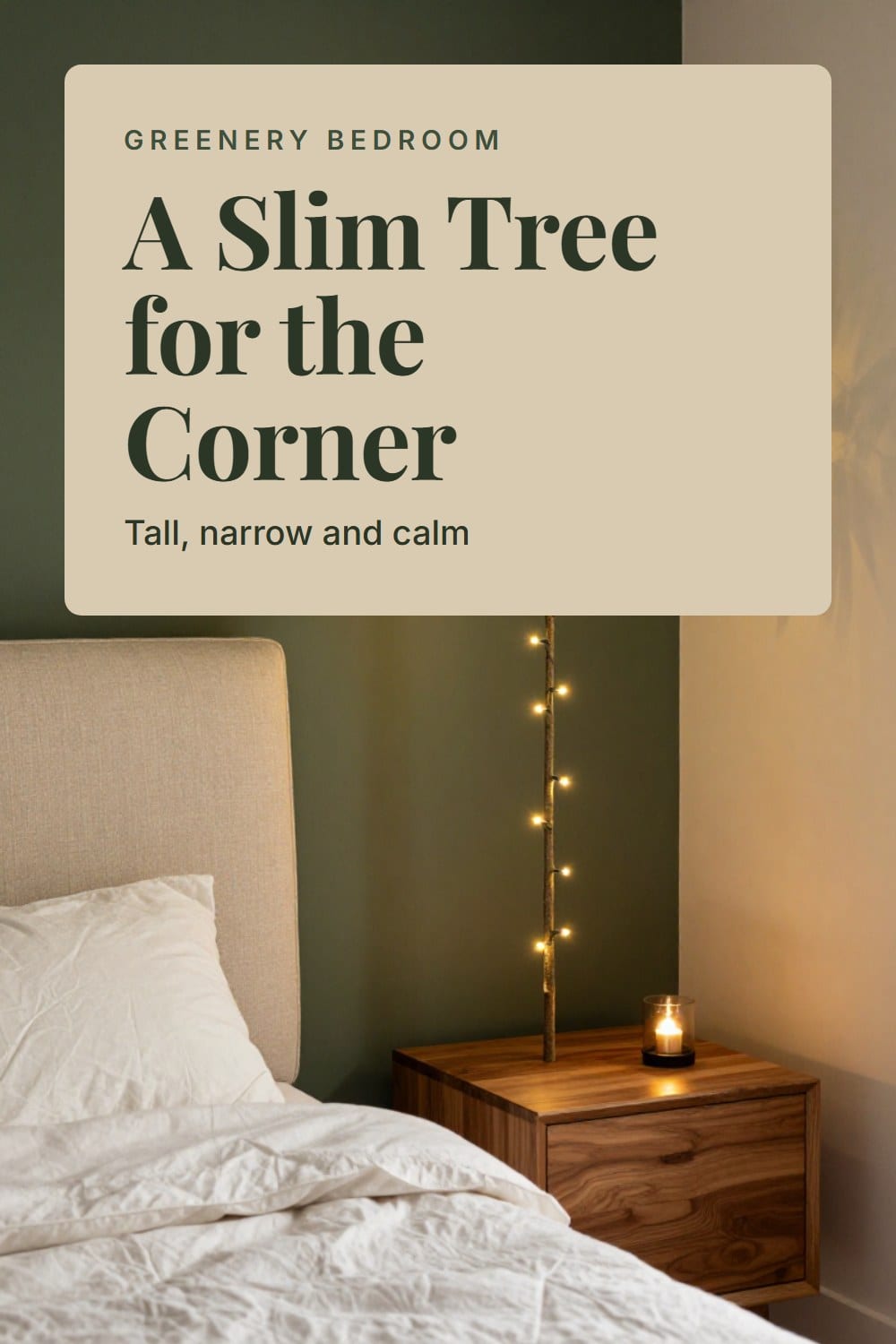
If the dresser is already full, go vertical. A slim artificial tree of 5 to 6.5 feet takes about 18 inches of floor and stands happily in a corner, diagonal to the bed if you can manage it. Keep it a few inches off the walls so the branches can open, and leave at least 30 inches of clear path between the tree and the nearest piece of furniture.
Skip the corner next to a radiator or heating vent. Even an artificial tree looks tired when the warm air blows on it all day, and a cut tree in that spot will be bare by the 20th. The corner opposite the foot of the bed is usually the sweet spot. You see it from the pillow, and nobody rolls into it.
Making a thin tree look full
Most small trees ship looking flat, with every branch tip folded to the trunk. Fluff them. Start at the bottom, work upward, and bend each tip up and out, then separate the little side twigs so they fan. Do the inside first, then the outer tips. It takes about fifteen minutes and it does more for a slim tree than any ornament will.
If gaps remain, tuck in three or four clipped stems of real cedar or boxwood where the branches thin out. They add depth and a faint, true green that plastic cannot fake. Add the lights after the fluffing, never before.
Living trees, and what to know about Norfolk Island pine and spruce
A living tree is the most beautiful option and the one that needs the most honesty. Two plants show up in the stores, and they could not be more different.
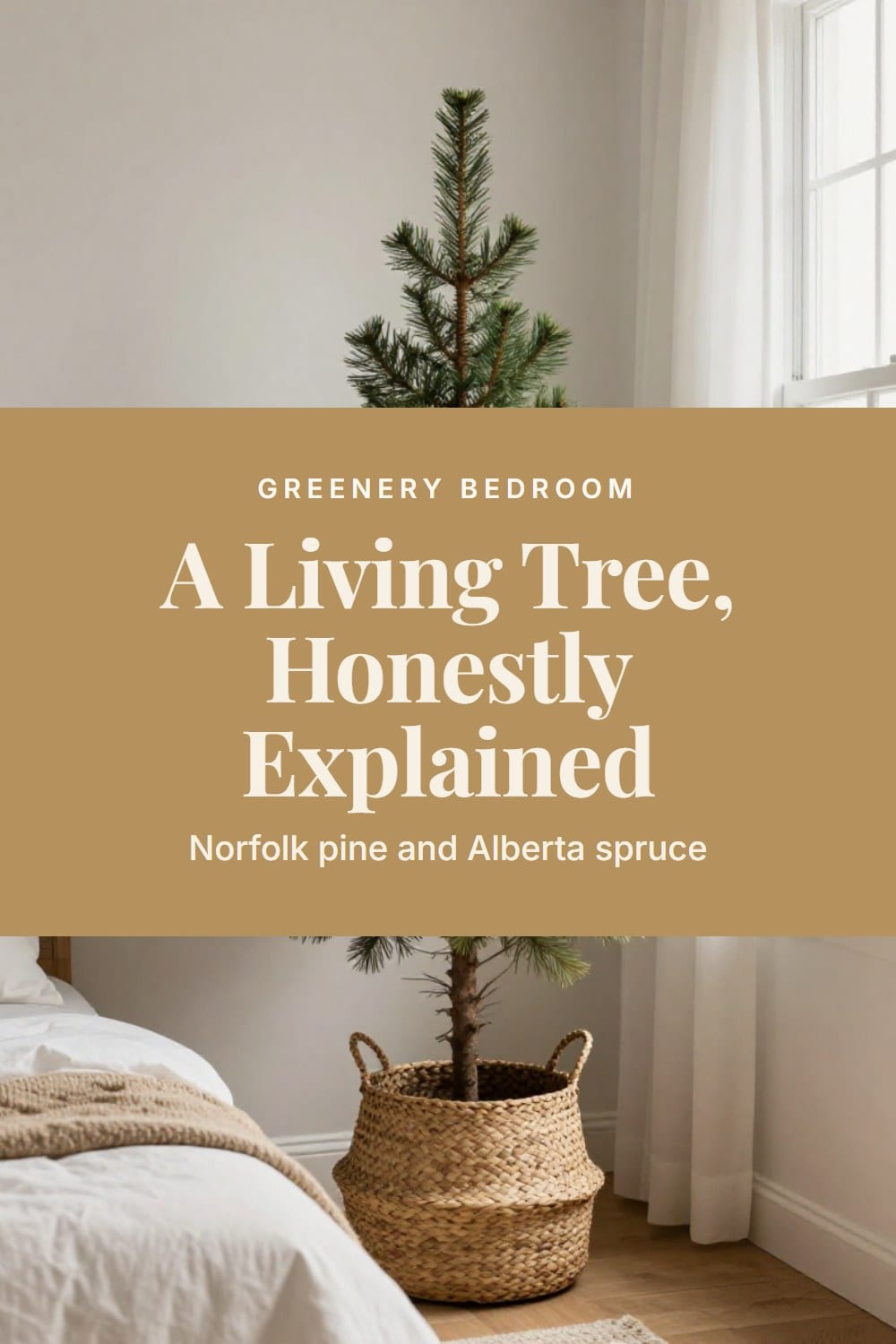
Norfolk Island pine (Araucaria heterophylla) is not a true pine. It is a tropical tree from the South Pacific that happens to grow in neat tiers, and it is a houseplant, full stop. Give it a bright window, a room around 60 to 72 degrees, and water when the top inch of soil is dry. Give it a quarter turn every week so it does not lean. The branches are soft and spaced, so hang only very light ornaments: small wood beads, little paper stars, tiny matte glass balls. A heavy bauble will bend a branch for good.
The good news is that it stays. After Christmas it is a houseplant with a story, and next December it will be a little taller.
Dwarf Alberta spruce is an outdoor tree. It looks wonderful by a bedroom window, but heated indoor air dries it quickly, so it should spend only a week or two inside before it goes back out. Set it in the coolest, brightest room you have, water when the soil begins to dry, and ease the transition with a few days on a cold porch or in a garage at each end. Skipping that step is how the needles brown.
I kept one for three weeks once, because it looked so good and I could not bring myself to move it. By the end it was brown from the inside out, and it never fully recovered. Two weeks is the honest limit. When it goes back to the front steps, it joins the quiet winter porch look that carries the front steps into February.
Warm white lights on a timer
Light is what makes a bedroom tree feel calm instead of festive-loud. Choose warm white, around 2700K, the same color as a good lamp bulb. Cool white looks like a clinic, and multicolor looks like the lobby of a motel. Copper wire micro LEDs are my pick because the wire disappears into the branches, and a strand of about 100 lights suits a 2 to 3 ft tree.
Buy battery-powered strands with a built-in timer. The common setting is 6 hours on and 18 off, so if you switch it on at 5 in the evening, it goes out around 11 and comes back the next dusk without you thinking about it. Skip any flashing or twinkling mode. A tree that blinks in your peripheral vision is not restful.
To string them, start at the trunk and weave out along each branch and back, rather than wrapping the tree like a barber pole. The lights sit inside the tree, which gives it that lit-from-within glow instead of a net of bulbs on the surface.
Fewer ornaments, in green, wood and cream
A small tree punishes excess. About fifteen to twenty ornaments suit a 30 inch tree. The palette that keeps a bedroom restful is sage and olive glass in a matte finish, turned wood beads, small brass bells, cream velvet bows cut from 1 inch ribbon, and a few dried orange slices if you like something earthy. Christmas red can show up once, as a single tiny berry or a ribbon end. More than that and the tree starts to shout.
Keep ornaments small. On a tabletop tree they should measure 1 to 1.5 inches, on a slim tree about 2 inches. Hang the heavier ones near the trunk and the lightest near the tips. Work in this order: lights, ribbon, the largest ornaments, then the small fillers, then a topper. For the topper, a tiny brass star or a single sprig of cedar tied with ribbon looks better than a full-sized star.
The sage and olive family is worth borrowing from a whole room scheme. If you want the same colors on the bed and walls, a sage green Christmas bedroom shows how the tree fits in with everything else.
The base does half the work
Nothing spoils a good tree faster than a visible plastic stand. Hide it. A wide seagrass or willow basket lined with a folded cream linen cloth is the easiest answer. A heavy ceramic crock does the same job for a tabletop tree and adds weight so it will not tip. On a dresser, a round wooden slice under the crock protects the finish.
For a living tree, keep it in its plastic nursery pot, set that inside a cachepot or basket, and put a saucer in between. A watering mishap on a walnut dresser leaves a white ring that is a nuisance to sand out. Ask me how I know.
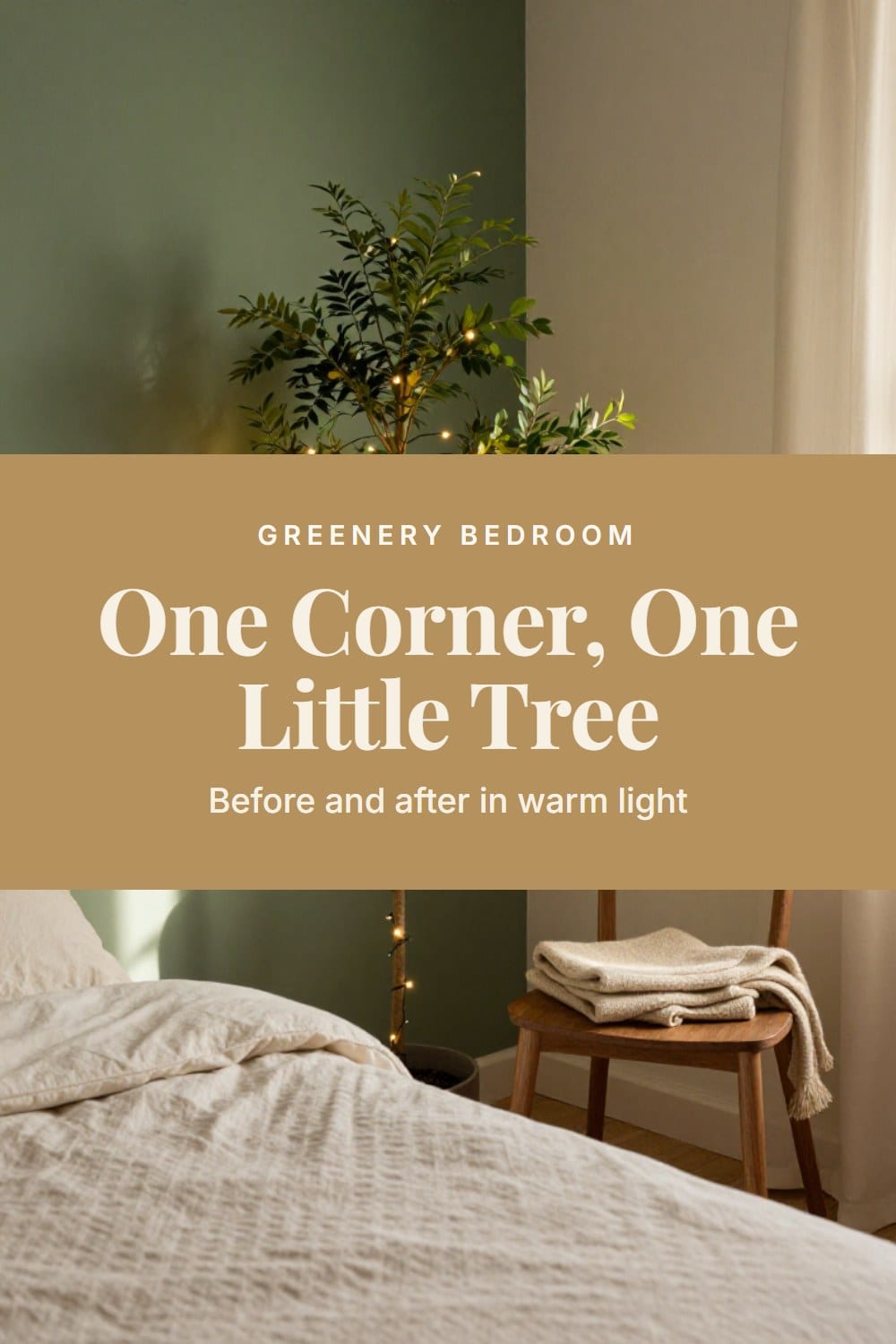
Where the tree actually goes
Think in sight lines. The best spot is one you can see while lying down: the dresser across from the bed, or a corner on the diagonal. A deep windowsill also works for a tabletop or living tree, though the glass runs cold, so check that nothing touches it overnight.
Keep the tree at least three feet from heaters and vents, and away from the closet door or the path to the bathroom. If you have already hung greenery over the bed, put the tree on the far side of the room so the two do not compete. The headboard garland and the tree should feel like two quiet notes, not a duet.
Putting it up, taking it down
Plan this in November. An artificial tree can go up the weekend after Thanksgiving and stay until the first week of January. It has no clock. A living Norfolk Island pine can come in about the same time, since it lives with you all year anyway.
A cut tabletop fir is different. In a heated bedroom, fresh greenery dries fast, so plan on two to three weeks of good looks. Put it up around December 10, keep the water topped up, and it will hold through Christmas. A dwarf Alberta spruce comes in around the 15th and goes out by the 28th.
Take everything down by the weekend after New Year's. A dry tree in a warm room is a fire risk, and a bare corner on January 10 feels sadder than one cleared on January 3. If you miss the fresh smell of fir when it goes, a few cut sprigs on the nightstand will do it better than a tree can, and this guide to a Christmas-smelling bedroom covers how to do it safely.
The Small Tree Bedroom Checklist
The printable is being finished. It will live here, free, with no sign-up wall.
Frequently asked
How big should a small Christmas tree be on a dresser?
Can I keep a Norfolk Island pine for next Christmas?
How long can a dwarf Alberta spruce stay indoors?
Is it safe to leave tree lights on overnight?
Sarah Whitmore
she keeps the teak, she oils it in spring
Sarah has furnished the same porch three times and finally stopped. She writes about what actually survives a decade outdoors — which wood silvers, which fabric fades, and which inexpensive piece quietly reads the same as the expensive one.
SarahMore from this corner
 Bedroom Sanctuary
Green Gingham Bedding: How to Style It So It Looks Grown-Up
Green gingham bedding can look calm and collected instead of nursery. Here is how to choose the check size, keep it to one layer, mix it with other patterns and pair it with wood so the bed looks grown-up.
Oct 25, 2026 · 10 min read
 Bedroom Sanctuary
Olive Green Bedding Ideas: How to Make a Green Bed Look Collected
Olive green bedding ideas that make a bed look collected instead of matched: the three-tone rule, the fabrics that read expensive in green, what goes on top, and what belongs on the walls behind it.
Oct 22, 2026 · 11 min read
 Bedroom Sanctuary
What Color Walls Go With Green Bedding? Six Pairings That Work
Six wall colors that make green bedding look chosen on purpose: warm white, greige, soft plaster pink, taupe, pale sage and deep chocolate or charcoal. Each one comes with the green it suits, how your light changes it, and the wood that ties it together.
Oct 20, 2026 · 11 min read