What Actually Holds Up on a Patio Through Fall Rain and Wind
Rain doesn't ruin a fall patio -- wet leaves and wind do. Here's what actually holds up through ten weeks of autumn weather, and the ten-minute pass that keeps the space usable.

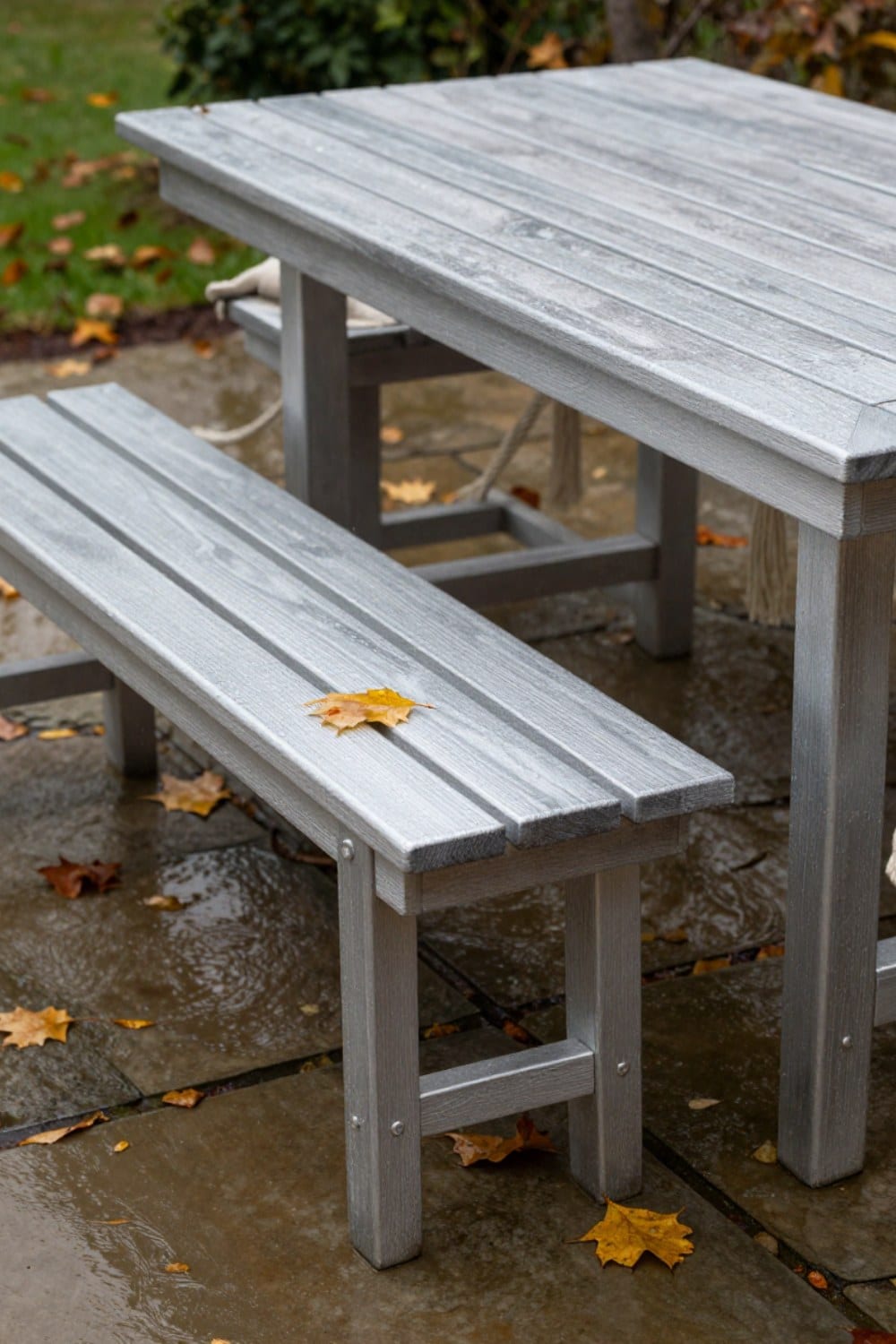
Summer tests a patio with heat, which is forgiving. Fall tests it with ten straight weeks of rain, wind, and wet leaves, which is not. Most of what looks wrong out there in October was never really the season's fault -- it's water that had nowhere to go, or wind that found a flat surface to grab hold of.
This isn't the winterizing conversation. That's a separate job, for a separate month -- covers, storage, the things you do once the space is actually finished for the year. This is about the space while it's still working: the chair you're still sitting in, the table you're still eating dinner at, straight through to the point the cold genuinely arrives.
Wet Leaves Are the Real Enemy, Not the Rain
Outdoor furniture is built to survive rain. What it isn't built to survive is a wet leaf sitting on it for a week, which is a different and much more specific problem than "it got rained on."
A single maple or oak leaf left on a teak tabletop through a run of dew and drizzle leaves a tannin stain -- a dark, faintly reddish shadow, the exact shape of the leaf, pressed right into the grain. It comes out eventually, with sanding and patience. It's a great deal easier to never let it happen.
On a rug, a wet leaf holds a damp footprint against the fiber, and if the rug is sitting on stone that doesn't drain, that footprint can turn to mildew before you've even noticed the leaf was ever there. In a chair joint -- the seam where an arm meets a seat rail, where two boards overlap and water has nowhere obvious to go -- a trapped leaf holds moisture against the wood or an untreated fastener and starts the kind of rot you don't see until it's already structural, usually the following spring.
Sweeping isn't tidying up. It's the single highest-leverage thing you can do for a fall patio, and it takes less time than deciding what to sweep it with. Fall porch and patio ideas that still look right in November assumes this step happens first -- everything else is styling on top of it.
Silvering Isn't Damage -- and Wet Teak Is the Wrong Teak to Oil
Untreated teak turns a soft, even grey over its first year outside. That's oxidation of the surface only -- the wood underneath hasn't changed, and its own natural oils are still keeping it from rotting. The 2026 move, if you actually want the piece to read as established rather than fussed-over, is to let it. It's teak doing exactly what teak is built to do, and fighting it season after season is a losing, endless argument.
What you shouldn't do, in October, is reach for the oil can. Oil or sealer only works on teak that's clean and fully dry, ahead of a stretch of genuinely dry weather so the finish can actually cure into the grain. That window is late summer, before the fall rain gets regular, or a dry stretch in spring. Oil a piece once autumn's wet weeks have started and you're sealing a surface that's about to spend ten weeks getting rained on -- you trap moisture under the finish instead of letting it sit harmlessly on top of the grain, which is a worse outcome than doing nothing at all. The materials library's teak page walks through what each stage of that silvering should actually look like, so you're not guessing whether yours is aging well or just aging.
TeakGrey is the finish, not a problem -- and once the rain sets in, the oil stays in the shed until spring.here's what actually happens →that's the whole story
Left alone, teak turns a soft silver-grey within a year — evenly, if it gets even light. This is oxidation of the surface only; the wood beneath is unchanged and its natural oils keep it from rotting. Oil it if you want the honey colour back, and understand you are then committed to oiling it every spring. Grade A (heartwood, tight grain, no knots) silvers evenly; lower grades go blotchy. Nothing about the greying shortens its life.
Upkeep: One afternoon a year, at most. None, if you like grey.
Give the Water Somewhere to Go
Most of what fails on a fall patio fails because water sat still. A thick cushion on a flat, solid seat holds a shallow puddle for hours after a storm passes -- long enough to soak through to the foam underneath. A slatted wood or metal seat, by contrast, sheds the same rain in minutes, because there's simply somewhere for it to drain.
The same logic runs underfoot. A rug laid directly on a slab that doesn't drain -- a low spot, a sealed paver joint, a corner that never quite dries -- stays wet from underneath long after the top looks fine, which is exactly how a rug starts smelling musty without anyone ever seeing it get properly rained on. Lift it after a hard rain, let both sides see air, and put it back. It's a ten-minute habit that adds a full season to a good rug's working life.
Wind Is the Thing That Actually Wrecks a Patio
Rain gets the attention, but wind does the real damage in a fall storm. A light cast-aluminum chair -- genuinely light, which is exactly why it's easy to carry in and out all summer -- will travel clean across a patio in a real autumn gust, and a traveling chair is how a glass tabletop or a window ends up broken. A powder-coated steel frame, heavier and lower, simply stays where you left it.
Umbrellas are almost always the first thing to actually break. Anything with a big flat face -- an open umbrella, a tall planter, a leaned-up cushion -- is a sail as far as an autumn gust is concerned, whether or not anyone designed it to be one. Close it, weight it, or bring it in before the wind picks up, not after.
Cast aluminiumWon't rust, won't chalk badly in fall's weaker sun -- but it's the piece you tie down before a windy night.here's what actually happens →that's the whole story
Aluminium cannot rust, which removes the failure that ends most metal furniture. What it does instead is chalk: the finish oxidises to a fine white powder that comes off on your hand and dulls the colour. A wash and a coat of automotive wax restores it. It is also light — genuinely light — which is a virtue on a deck and a liability in a gale.
Upkeep: A wash and a wax each spring. Something to tie it down.
Teak vs. Acacia in a Wet Autumn
Both arrive looking like the same warm brown wood. A wet fall is where they stop behaving like the same wood.
| Teak | Acacia | |
|---|---|---|
| Water absorption | High natural oil content sheds most surface water before it soaks in. | Lower oil content lets moisture into the grain far more readily. |
| Tannin and leaf staining | Stains lighten as the surface silvers over the following weeks. | Stains sit closer to the surface color and read as dirt rather than weather. |
| Joint movement, wet-to-dry cycles | Dense, tight grain moves very little between a soaked morning and a dry afternoon. | Looser grain swells wet and shrinks dry, which is exactly how checking -- fine surface cracks -- gets started. |
| Silvering | Even, all-over grey that reads as intentional and gets better with age. | Uneven, blotchy graying that reads as neglect rather than patina. |
| What a wet season costs it | Nothing structural. A dull surface if you were expecting honey brown. | Checking, occasional swelling at the joints, and a shorter runway before it needs real attention. |
The verdict: If a piece is going to live outside through a genuinely wet fall without a cover or much fuss, teak is the one that shrugs it off. Acacia can do the job too, but only if you're honestly willing to oil it every spring and bring it under cover before the real cold -- skip that discipline and a wet autumn is where it starts to show.
Drying Beats Covering, Every Time
A cover thrown over a wet chair doesn't protect it. It traps the wet against the cushion, the frame, or the joint, and seals in exactly the moisture you were trying to keep out -- with none of the airflow that would have let it dry on its own. Cover things once they're dry, or don't cover them at all until you're ready to do it properly.
What Holds Up, and What Struggles
After a few wet autumns out here, the pattern is consistent enough to plan around. Some materials are built for exactly this stretch of weather. Others are borrowing time.
- Teak -- sheds water, silvers instead of rotting, barely moves through wet-dry cycles
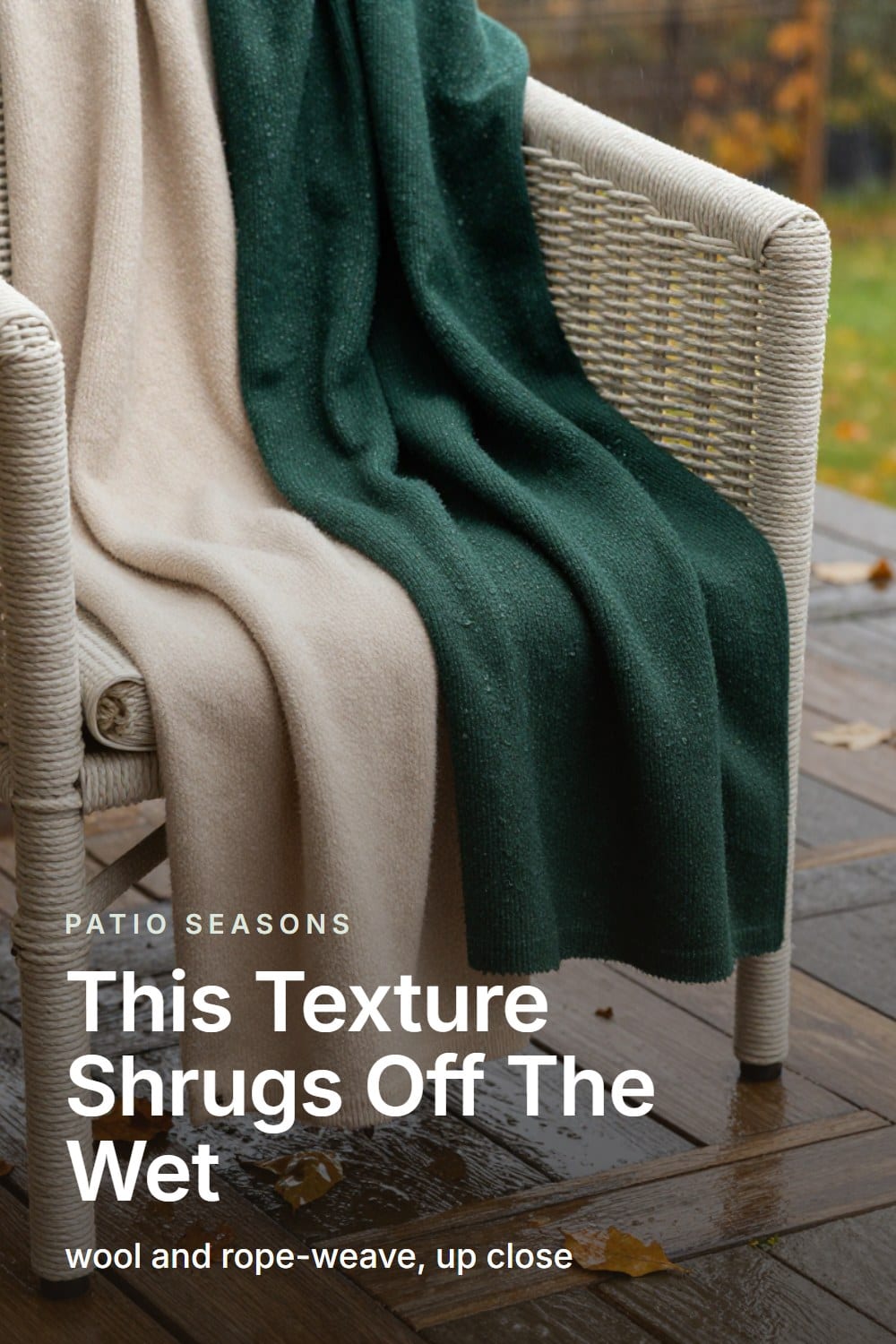
- Rope-weave seating -- UV-stable and rot-proof, though it stiffens in cold and damp and softens again once it warms
- Powder-coated steel -- the coating shrugs off rain; only the welds and cut edges need a fall glance
- Solution-dyed performance fabric -- colored through the fiber, so a soaking doesn't blotch or bleed it
- Polypropylene rugs -- take a hose, take a storm, and dry fast once they're lifted off a wet slab
- Printed polyester cushions -- the pattern sits on the surface and streaks or fades unevenly when it's wet often enough
- Closed-cell foam that's already old -- once the outer skin cracks, it wicks water in and stays soaked for days
- Untreated steel fasteners -- the single small part most likely to rust through a frame that otherwise looks fine
Solution-dyed acrylicFades slowly and evenly through a wet fall -- it's the stitching, not the color, that gives out first.here's what actually happens →that's the whole story
Colour in solution-dyed acrylic goes all the way through the fibre rather than sitting on it, so it fades slowly and evenly instead of going patchy. Expect a gentle softening of tone over five or six seasons, which most people never notice. What ends a cushion is the stitching and the zip, both of which sit on the surface and take the full sun. Ask what the thread is made of; nobody does.
Upkeep: Brush them off. Bring them in when the season turns.

Common Mistakes That Turn Ten Usable Weeks Into a Loss
- Covering furniture while it's still wet from the last storm, which is how a cover becomes the problem instead of the fix
- Oiling teak in October because it looks dull, then sealing autumn's moisture in under the new finish
- Leaving a flat cushion on a solid seat through a whole rainy week instead of tilting it up between uses
- Leaving an umbrella open overnight because the forecast said light wind, not the gust that actually showed up
- Letting a rug sit on a low, slow-draining corner of the patio all season instead of rotating it to somewhere that dries
- Skipping the joints -- the one place a chair or table actually starts to fail is rarely the flat surface everyone checks
The Ten-Minute Pass After a Storm
Worth Getting Right Once
A powder-coated steel frame with a slatted seat
It sheds rain by design, stays put in wind by weight, and the only upkeep it ever asks for is a glance at the welds each fall.
A well-made polypropylene rug underfoot
It takes a hose, takes a storm, and dries fast once it's lifted -- durability without teak's or acacia's seasonal discipline.
The After-the-Storm Ten-Minute Patio Pass
The printable is being finished. It will live here, free, with no sign-up wall.
Frequently asked
Should I bring cushions inside every time it rains in the fall?
Is it too late to oil my teak table once fall has started?
How do I stop my patio furniture from blowing around in fall wind?
Is a leaf-stained teak table ruined?
Sarah Whitmore
she keeps the teak, she oils it in spring
Sarah has furnished the same porch three times and finally stopped. She writes about what actually survives a decade outdoors — which wood silvers, which fabric fades, and which inexpensive piece quietly reads the same as the expensive one.
SarahMore from this corner
 Patio Living
How to Protect Teak Furniture in Winter (What Actually Needs Doing — and What Doesn't)
Teak has a reputation as the fussy, high-maintenance wood on the patio. It's actually the opposite -- one of the only materials built to winter outside without a second thought, as long as you stop treating moisture and cold as the same threat.
Oct 30, 2026 · 10 min read
 Patio Living
How to Winterize Patio Furniture the Right Way (So It Comes Out Perfect in Spring)
Winterizing patio furniture isn't complicated, but it does ask you to treat every material differently. Here's the material-by-material sequence -- clean, dry, cover or store, elevate -- that keeps teak, aluminium, and wicker looking right through to spring.
Jan 24, 2026 · 11 min read
 Patio Living
How to Store Outdoor Cushions for Winter So They Come Out Spotless
Mildew doesn't come from cold, it comes from moisture sealed inside the foam. Here's how to dry outdoor cushions completely and store them somewhere breathable, so they come out in spring looking like you just bought them.
Jan 15, 2026 · 9 min read